

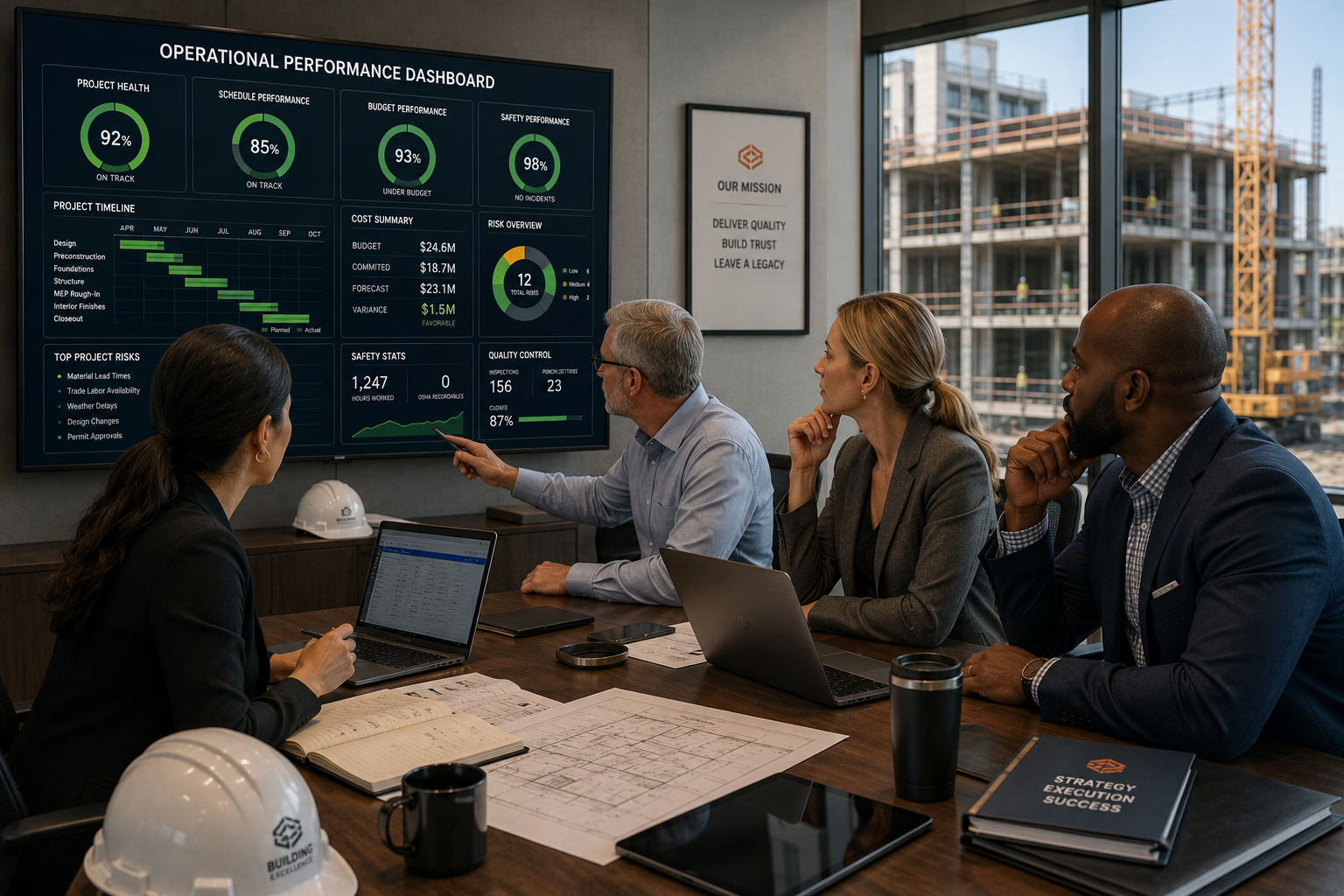
Most construction companies don’t realize where operational friction exists until it begins affecting projects.
Schedules slip.
Communication slows.
Information becomes difficult to locate.
Workarounds become normal.
Leadership spends more time solving problems than improving operations.
These issues rarely begin with one major failure.
They usually develop gradually as communication, field support, project information, risk management, and operational consistency become disconnected.
That’s why we developed the Construction Technology Framework™ Assessment.
The 5 Pillars of the Construction Technology Framework™
Rather than evaluating technology alone, this assessment helps construction leaders evaluate the operational systems that keep projects moving.
The goal isn’t to assign a grade.
The goal is to identify opportunities to reduce friction, improve consistency, and strengthen the systems that support successful projects.
How to Use This Assessment
For each statement below, score your organization from 1 to 5.
1 = Strongly Disagree
2 = Needs Significant Improvement
3 = Sometimes True
4 = Mostly True
5 = Consistently True
At the end, total your score and compare it with the assessment guide.
Be honest.
This assessment is designed to identify opportunities, not perfection.
Pillar 1: Connect Teams
Strong communication keeps projects moving.
Score each statement.
Communication
□ Our communication process is consistent across every project.
□ Office and field personnel receive project updates at the same time.
□ RFIs and project questions are answered promptly.
□ Employees always know where to find current project information.
□ Communication responsibilities are clearly defined.
Your Score
____ / 25
Want to strengthen this area? Learn how better communication improves project execution in Why Construction Communication Breakdowns Cost More Than Most Contractors Realize.
Pillar 2: Support the Field
Field teams should spend their time building projects.
Not searching for information.
Field Support
□ Field personnel have reliable internet connectivity.
□ Mobile access to project information is consistent.
□ Employees rarely rely on personal devices or personal email.
□ Field teams can quickly access drawings, RFIs, and documentation.
□ Technology supports productivity instead of slowing work.
Your Score
____ / 25
Want to strengthen this area? Learn why field teams create workarounds and how better systems reduce operational friction in Why Field Teams Create Workarounds (And What It Costs Construction Companies).
Pillar 3: Manage Project Information
Trusted information creates confident decisions.
Project Information
□ Everyone works from current drawings and specifications.
□ Version control is consistent.
□ Project documents are organized logically.
□ Employees can locate information quickly.
□ Teams trust the information they are using.
Your Score
____ / 25
Want to strengthen this area? Learn how trusted project information reduces rework and improves productivity in The True Cost of Outdated Drawings and Project Information.
Pillar 4: Reduce Risk
Preparation protects project continuity.
Operational Risk
□ Multi-factor authentication is enabled.
□ Backups are tested regularly.
□ Disaster recovery procedures are documented.
□ Employees receive cybersecurity awareness training.
□ Leadership understands how operations would continue after a disruption.
Your Score
____ / 25
Want to strengthen this area? Learn why operational resilience matters more than security software in Construction Cybersecurity Isn’t About Technology. It’s About Project Continuity.
Pillar 5: Keep Work Moving™
Everything in the framework supports this outcome.
Operational Continuity
□ Small problems rarely stop project progress.
□ Teams recover quickly after unexpected disruptions.
□ Communication remains consistent under pressure.
□ Leadership has visibility into project operations.
□ Operational systems support continued project momentum.
Your Score
____ / 25
Want to strengthen this area? Learn how leading contractors build operational systems that keep projects moving in What Happens When a Construction Project Loses Momentum?
Calculate Your Results
Add the five pillar scores together.
Maximum Score:
125 Points
105–125 Points
Operationally Mature
Your organization has developed strong operational systems.
Continue refining consistency as your company grows.
Even high-performing contractors should periodically evaluate their processes to identify opportunities for continuous improvement.
85–104 Points
Strong Foundation
Your organization has many effective operational systems.
However, small gaps may already be creating unnecessary friction.
Addressing those areas now can prevent larger problems as your company continues growing.
65–84 Points
Operational Friction Is Increasing
Your teams are likely relying on workarounds more often than standardized systems.
Communication, project information, or field support may be affecting productivity.
Improving these areas can significantly increase operational consistency.
Below 65 Points
Significant Improvement Opportunities Exist
Your projects are likely succeeding because of the efforts of your employees rather than the strength of your operational systems.
As your organization grows, those weaknesses become increasingly difficult to manage.
This is often the point where contractors begin experiencing recurring delays, inconsistent communication, and reduced operational visibility.
What Your Score Doesn’t Tell You
Numbers alone don’t tell the entire story.
Two contractors can receive the same score for very different reasons.
One company may struggle with communication.
Another may have excellent communication but weak continuity planning.
The value of the Construction Technology Framework™ Assessment isn’t simply the score.
It’s understanding why the score exists.
That’s where meaningful operational improvements begin.
Real Example
A Southern California contractor believed technology was their biggest challenge.
After completing an assessment similar to this one, leadership discovered something different.
Technology wasn’t the primary issue.
Communication standards varied between project managers.
Field teams relied on multiple workarounds.
Project documentation lacked consistency.
Recovery procedures had never been formally documented.
Rather than purchasing new software, the company focused on improving operational consistency across the five pillars.
Within months, leadership reported:
- Faster communication
- Better project visibility
- Reduced operational friction
- Greater accountability
- More predictable project execution
The biggest improvement wasn’t technology.
It was alignment.
Why This Matters for Construction Leaders
Construction companies rarely struggle because employees don’t work hard.
They struggle because operational systems haven’t kept pace with company growth.
The strongest contractors build systems that support communication, field operations, project information, risk reduction, and continuity.
Those systems create predictability.
Predictability creates confidence.
Confidence keeps projects moving.
Why Contractors Across Southern California Use M Squared Networks
For more than a decade, M Squared Networks has helped construction companies throughout Orange County, Los Angeles County, Riverside County, and the Inland Empire strengthen the operational systems behind successful projects.
What “Keeping Projects Moving™” Actually Requires Behind the Scenes
The Construction Technology Framework™ Assessment was developed to help contractors identify operational friction before it becomes project disruption.
Because improving operations begins with understanding where opportunities exist.
Final Takeaway
Operational excellence isn’t achieved by purchasing more technology.
It’s achieved by creating systems that consistently support communication, field productivity, trusted project information, operational resilience, and project continuity.
The strongest construction companies don’t simply react to problems.
They identify weaknesses early.
Improve them intentionally.
And continue building organizations that can Keep Projects Moving™.
Your Next Step
Your score provides a snapshot of your current operational maturity.
The next step is understanding why certain areas scored lower than others and identifying practical improvements that reduce operational friction.
Whether your biggest opportunity is communication, field support, project information, operational risk, or project continuity, each pillar works together to support one goal:
Keep Projects Moving™.
Ready to See How Your Company Scores?
This self-assessment is a great starting point.
A Construction Technology Framework™ Assessment goes deeper by evaluating your actual operational environment, identifying hidden friction points, and providing practical recommendations aligned with all five pillars of the framework.