

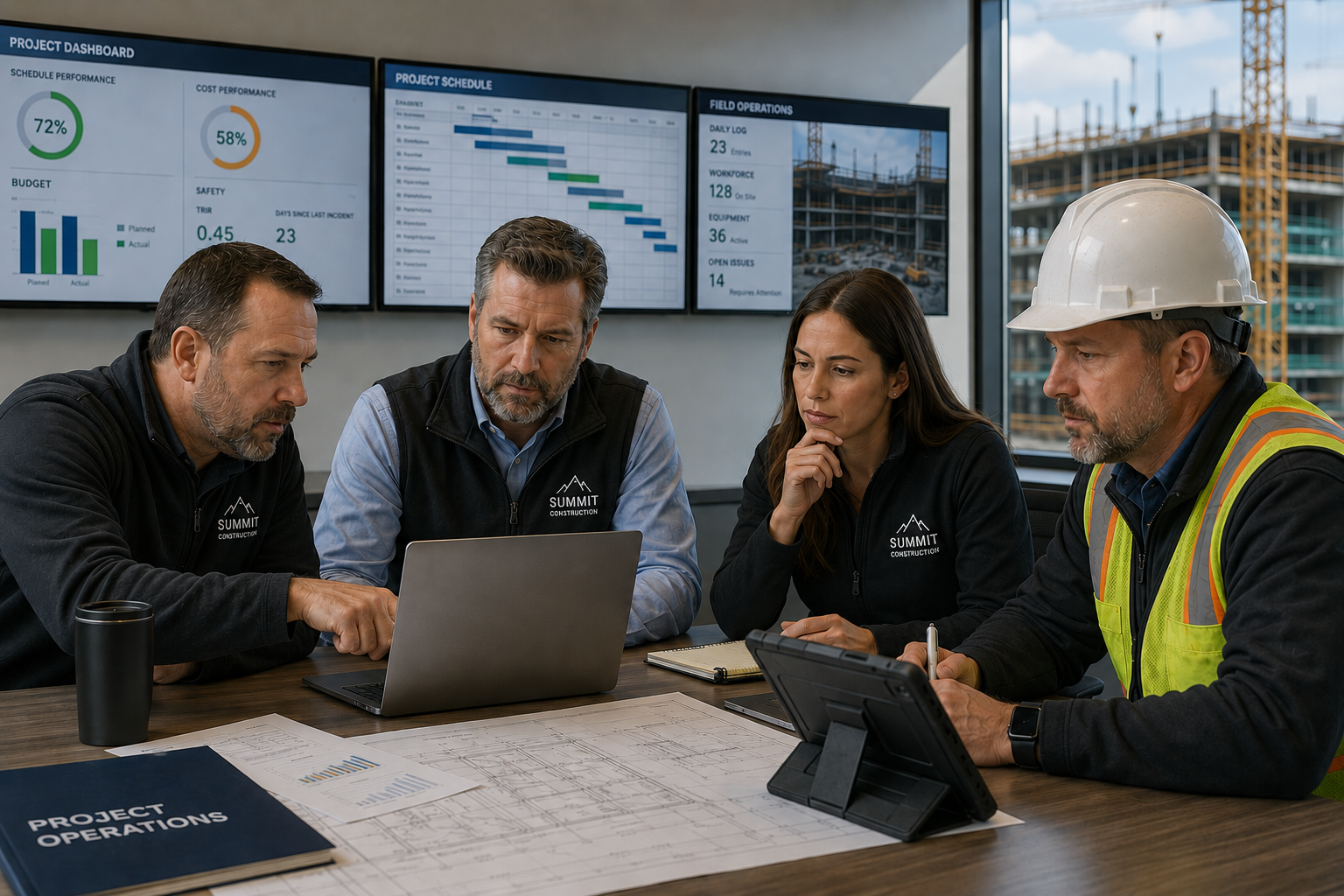
Most construction companies don’t struggle because they lack technology.
They struggle because technology, communication, project information, field operations, and risk management are often managed separately.
As companies grow, those disconnects create friction.
Communication slows.
Information becomes harder to find.
Field teams create workarounds.
Risk increases.
Projects become more difficult to manage.
Many contractors attempt to solve these problems by purchasing new software, adding new tools, or upgrading infrastructure.
Sometimes those investments help.
Often they simply add complexity.
The real challenge is not technology.
The real challenge is operational alignment.
Learn how operational misalignment begins in:
The Construction Technology Framework™: Why IT and Field Operations Often Don’t Align
This is why we developed the Construction Technology Framework™.
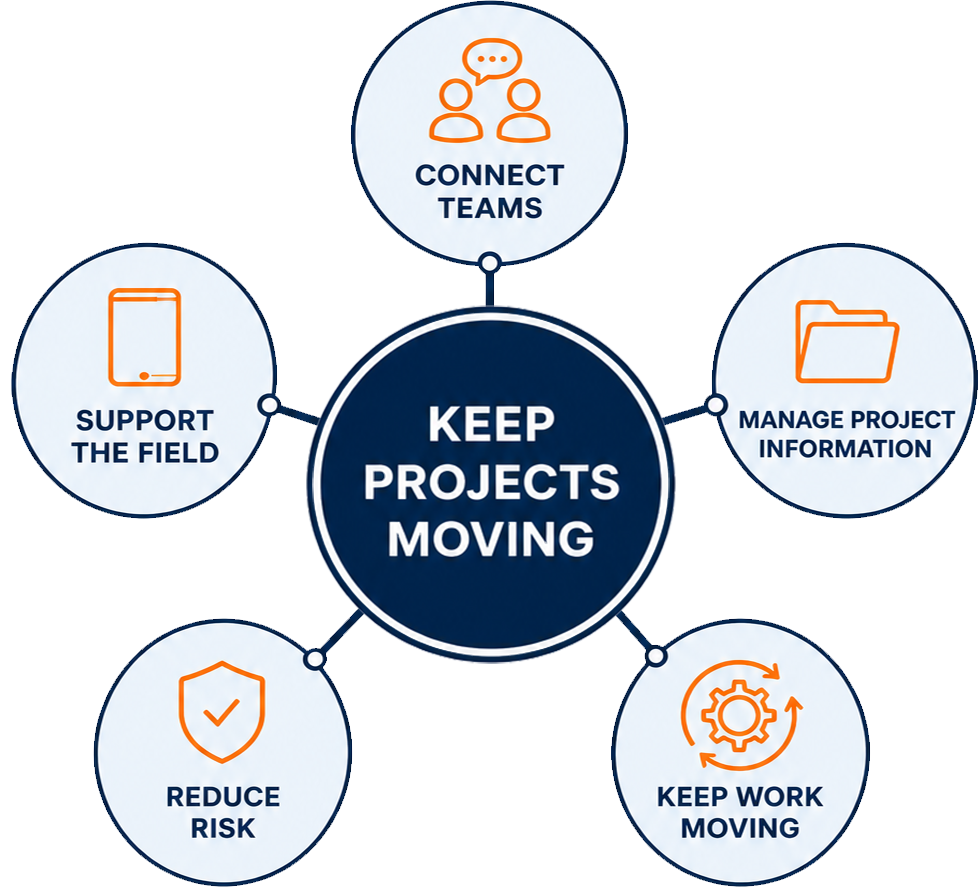
Rather than focusing on individual technologies, the framework focuses on five operational pillars that support project execution.
The goal is simple:
Keep Projects Moving™
When all five pillars are working together, projects move more efficiently, teams become more productive, risk decreases, and leadership gains greater visibility into operations.
The Construction Technology Framework™ At A Glance
The Construction Technology Framework™ was developed from years of helping construction companies solve communication challenges, support field operations, manage project information, reduce operational risk, and maintain project momentum.
Rather than focusing on individual technologies, the framework evaluates how technology supports the operational systems that keep projects moving.
Every recommendation, review, and technology decision should ultimately strengthen one or more of the five pillars.
When the pillars are aligned, projects operate more predictably.
When they are not aligned, operational friction increases.
The ultimate objective is simple: Keep Projects Moving™.
Why Construction Requires a Different Approach
Construction companies operate differently than most businesses.
Information moves between:
- Offices
- Jobsites
- Vehicles
- Project trailers
- Remote employees
- Subcontractors
- Vendors
- Clients
Every day, dozens of decisions rely on timely communication and accurate project information.
A delay in one area often creates problems elsewhere.
The challenge isn’t simply keeping technology operational.
The challenge is ensuring technology supports construction operations.
That is the purpose of the Construction Technology Framework™.
Pillar 1: Connect Teams
Communication drives construction.
Projects move at the speed of information.
Communication breakdowns are often one of the earliest signs of operational misalignment discussed in The Construction Technology Framework™: Why IT and Field Operations Don’t Align.
When communication is clear and consistent:
- Decisions happen faster
- Coordination improves
- Accountability increases
- Delays decrease
When communication breaks down:
- RFIs sit unanswered
- Change orders stall
- Teams operate from incomplete information
- Project momentum slows
Within the Construction Technology Framework™, communication is not treated as a technology issue.
It is treated as an operational requirement.
Leading contractors establish standardized communication processes that connect office staff, field teams, subcontractors, and leadership.
The objective is simple:
Make information available to the right people at the right time.
The Goal Of This Pillar
The goal of this pillar is ensuring project information reaches the right people at the right time so decisions can be made quickly and projects can move forward without unnecessary delays.
Signs This Pillar Needs Attention
- Teams rely on multiple communication methods for the same project
- Project updates are inconsistent between office and field personnel
- Employees frequently struggle to locate information they need
- RFIs experience unnecessary delays
- Communication processes vary from project to project
Pillar 2: Support the Field
Field teams are where projects become reality.
Yet many technology environments are designed primarily around office users.
This creates friction.
Superintendents, project managers, and field personnel depend on immediate access to:
- Drawings
- Specifications
- RFIs
- Change orders
- Inspection records
- Project documentation
When access becomes difficult, productivity declines.
Workarounds emerge.
Delays increase.
Support the Field focuses on creating consistent access to information regardless of location.
Whether a project is in Orange County, Los Angeles, Riverside County, or the Inland Empire, field teams should be able to access the information they need without unnecessary obstacles.
The field should never be waiting on technology.
liable field access is one of the key requirements discussed in What “Keeping Projects Moving™” Actually Requires Behind the Scenes.
The Goal Of This Pillar
The goal of this pillar is ensuring field personnel have reliable access to the tools, systems, and information they need to remain productive regardless of location.
Signs This Pillar Needs Attention
- Crews regularly wait for information before proceeding with work
- Jobsites experience recurring connectivity problems
- Mobile access to systems is inconsistent
- Field teams create workarounds to access project information
- Productivity varies significantly between project locations
Pillar 3: Manage Project Information
Construction companies generate enormous amounts of information.
Including:
- Drawings
- Submittals
- RFIs
- Change orders
- Inspection reports
- Photos
- Contracts
- Permits
The challenge is not creating information.
The challenge is managing it.
When project information becomes disorganized:
- Employees lose confidence in data
- Duplicate records appear
- Teams create side systems
- Errors become more likely
One of the most expensive examples is outdated project documentation.
A drawing revision can take seconds to update.
The operational consequences can take days to correct.
Labor is repeated.
Schedules shift.
Inspections may need to be rescheduled.
Profitability suffers.
Managing project information is not administrative work.
It is operational infrastructure.
Information confusion is one of the most expensive forms of technology friction discussed in How Technology Friction Quietly Reduces Construction Profit Margins.
The Goal Of This Pillar
The goal of this pillar is ensuring project information remains accurate, organized, accessible, and trusted by everyone who depends on it.
Signs This Pillar Needs Attention
- Employees spend excessive time searching for project documents
- Multiple versions of drawings or specifications exist
- Teams maintain duplicate records in different locations
- Project information is difficult to locate during critical decisions
- Rework occurs because outdated information was used
Pillar 4: Reduce Risk
Every construction company faces risk.
Some risks are operational.
Some are financial.
Some are technological.
Examples include:
- Cybersecurity incidents
- Data loss
- Connectivity failures
- Device failures
- Vendor disruptions
- Compliance issues
Many companies treat risk as a separate initiative.
The Construction Technology Framework™ treats risk as part of project continuity.
Because when risk becomes reality, projects are affected.
Schedules are affected.
Productivity is affected.
Clients are affected.
Reducing risk is not simply about avoiding problems.
It is about protecting momentum.
The Goal Of This Pillar
The goal of this pillar is identifying and reducing operational, cybersecurity, and continuity risks before they impact projects, productivity, or profitability.
Signs This Pillar Needs Attention
- Backup and recovery processes have not been tested recently
- Employees are unsure how to respond to cybersecurity incidents
- Access permissions are inconsistent across systems
- Critical project information depends on a single employee or vendor
- Leadership lacks visibility into operational and technology risks
Pillar 5: Keep Work Moving
This pillar connects everything together.
Communication.
Field support.
Project information.
Risk management.
All of these exist for one reason:
To keep work moving.
Most projects are not delayed by one catastrophic event.
Many of these small disruptions are discussed in:
How Technology Friction Quietly Reduces Construction Profit Margins
More often, they slow down because of dozens of small disruptions:
- Missing information
- Delayed responses
- Connectivity issues
- Inconsistent processes
- Operational friction
The companies that consistently outperform competitors are those that remove friction before it impacts projects.
They build systems designed for continuity.
They create predictable operational environments.
They focus on maintaining momentum.
That is what Keep Work Moving™ represents.
The Goal Of This Pillar
The goal of this pillar is maintaining project momentum by reducing operational friction and ensuring work continues even when unexpected disruptions occur.
Signs This Pillar Needs Attention
- Small disruptions regularly delay project progress
- Teams rely on workarounds to stay productive
- Connectivity or technology issues frequently interrupt operations
- Projects slow down when key employees are unavailable
- Recovery from unexpected disruptions takes longer than expected
How the Five Pillars Work Together
What Happens When One Pillar Fails?
A communication issue becomes an information issue.
An information issue becomes a field productivity issue.
A field productivity issue creates project delays.
Project delays increase operational risk.
This is why the Construction Technology Framework™ evaluates all five pillars together rather than independently.
The pillars are interconnected.
When one weakens, the others are affected.
When all five are aligned, projects move more predictably and operational friction decreases.
Many contractors evaluate these areas independently.
Communication is handled separately.
Risk is handled separately.
Project information is handled separately.
Field support is handled separately.
The problem is that projects don’t operate in separate categories.
Everything is connected.
When communication improves, information becomes more effective.
When information improves, field productivity improves.
When field productivity improves, project momentum improves.
When risk decreases, continuity improves.
The framework works because the pillars support one another.
The objective is not optimization of individual systems.
This directly supports the concept discussed in:
What “Keeping Projects Moving™” Actually Requires Behind the Scenes
The objective is operational alignment.
Real Example
A growing Southern California contractor experienced recurring operational friction across multiple projects.
No major failures occurred.
Instead, small disruptions repeatedly slowed progress:
- Information was difficult to locate
- Communication varied between teams
- Field access was inconsistent
- Risk management was largely reactive
Each issue appeared manageable on its own.
Together, they created significant operational drag.
When leadership evaluated operations using the Construction Technology Framework™, they identified gaps across multiple pillars.
By improving communication standards, organizing project information, strengthening field support, and implementing continuity processes, the company reduced friction throughout the organization.
The result was not simply better technology.
The result was smoother project execution.
Why This Matters for Construction Leaders
Most contractors don’t need more technology.
This is one reason many traditional IT providers struggle to support construction companies effectively:
Why Most MSPs Don’t Understand Construction Operations
They need greater alignment.
The challenge is no longer deciding which software to buy.
The challenge is ensuring communication, field support, information management, risk reduction, and continuity are working together.
When those systems align:
- Productivity improves
- Visibility improves
- Risk decreases
- Delays are reduced
- Projects move more efficiently
That is the purpose of the Construction Technology Framework™.
Why Contractors Across Southern California Use M-Squared Networks
For more than a decade, M-Squared Networks has helped construction companies throughout Orange County, Los Angeles, Riverside County, and the Inland Empire align technology with operational outcomes.
The Construction Technology Framework™ was developed from years of supporting contractors facing communication challenges, information management issues, field support obstacles, operational risk, and project disruptions.
Because contractors don’t invest in technology for its own sake.
They invest in keeping projects moving.
Final Takeaway
The Construction Technology Framework™ is not a collection of software products.
Construction companies evaluating technology support should also read Why Most MSPs Don’t Understand Construction Operations.
It is a methodology.
A framework designed to help construction companies:
- Connect Teams
- Support the Field
- Manage Project Information
- Reduce Risk
- Keep Work Moving
When these five pillars work together, technology becomes an operational asset instead of an operational obstacle.
And that is how leading contractors create more predictable, efficient, and profitable operations.
How Does Your Company Score Across The Five Pillars?
Most construction companies have strengths in some pillars and hidden gaps in others.
The challenge is that operational friction often appears long before leadership recognizes it.
A Construction Technology Review evaluates your company across all five pillars of the Construction Technology Framework™:
✓ Connect Teams
✓ Support the Field
✓ Manage Project Information
✓ Reduce Risk
✓ Keep Work Moving
The review identifies operational gaps, technology friction, and opportunities to improve project momentum.