


Every new technology changes how construction companies work.
Today, artificial intelligence is helping teams summarize meeting notes, organize spreadsheets, draft emails, analyze project information, and answer technical questions faster than ever before.
Those are valuable capabilities.
However, AI also introduces an important business question that many organizations have not considered.
Should we be sharing all of this information in the first place?
Responsible AI starts with thoughtful decisions, not simply better technology.
Construction companies that take a few moments to review what they are sharing can often achieve the same results while exposing far less information.
Quick Answer
Before sharing project information with an AI platform, construction companies should review exactly what information is being provided and whether every detail is necessary. Removing customer names, employee information, project identifiers, and other unnecessary data helps reduce risk while still allowing AI to perform the task. Responsible AI begins with good business judgment.
1. Does AI Actually Need All of This Information?
One of the easiest mistakes to make is sharing an entire document when only part of it is needed.
Before uploading a file, ask yourself:
- Can employee names be removed?
- Can customer names be removed?
- Can project numbers be removed?
- Can project addresses be removed?
- Can identifying logos be removed?
Often, AI only needs the information directly related to the question being asked.
Providing less information rarely reduces the quality of the response.
2. Does This Identify My Customer?
Construction companies build long-term relationships based on trust.
Many documents contain information that identifies:
- Property owners
- General contractors
- Subcontractors
- Project names
- Jobsite locations
If those details are not necessary for the task, consider removing them before using AI.
3. Does This Include Employee Information?
Construction companies frequently work with documents that include employee information.
Examples include:
- Employee names
- Hours worked
- Phone numbers
- Email addresses
- Labor reports
Ask yourself a simple question.
Does AI actually need this information to help me?
If the answer is no, remove it before sharing the file.
4. Can I Remove Information Without Changing the Result?
This may be the most valuable question in the entire process.
Many employees discover they can remove identifying information while still receiving exactly the same AI response.
If removing information does not reduce the quality of the answer, it probably was not needed in the first place.
A few extra seconds reviewing a document before sharing it can significantly reduce unnecessary exposure.
5. Have I Reviewed the AI Response Before Using It?
AI can organize information.
AI can summarize information.
AI can draft content.
AI cannot accept responsibility for the final result.
Every AI-generated response should be reviewed by someone who understands the project, the customer, and the business before it is shared or acted upon.
AI supports people.
People remain responsible for every decision.
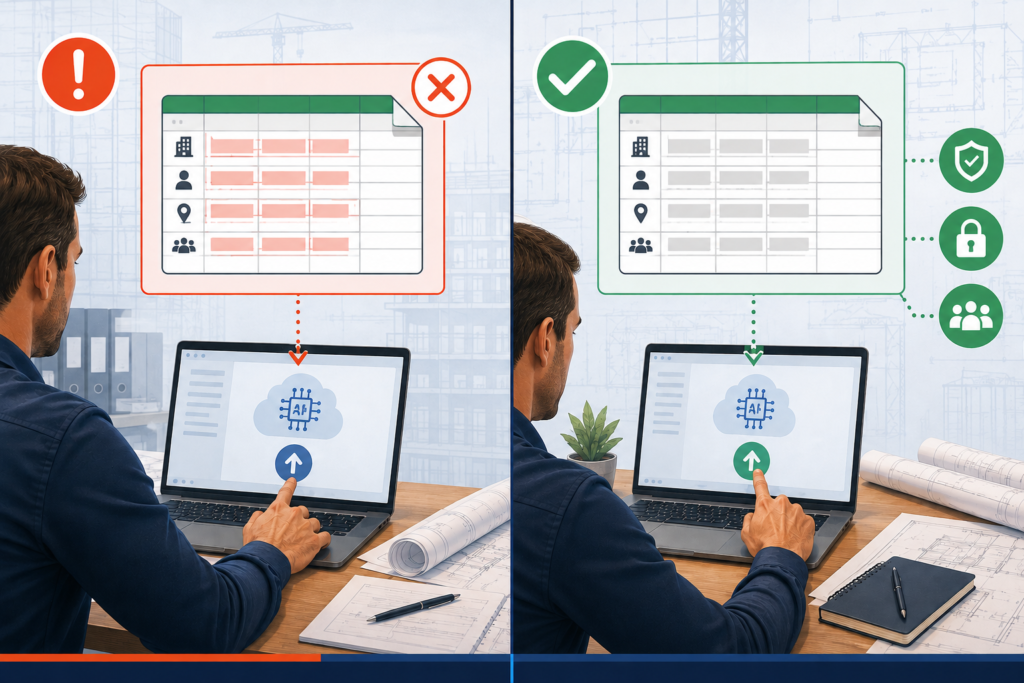
Common Scenario
A project engineer needs help organizing a labor report before a project review meeting.
To save time, they upload the spreadsheet into an AI application.
The file contains the general contractor’s logo, the subcontractor’s company name, employee names, hours worked, and several internal project details.
The AI successfully summarizes the report.
After reviewing what was shared, the employee realizes most of that information was unnecessary to accomplish the task.
The same result could have been achieved after removing the identifying information first.
The lesson was not that AI should be avoided.
The lesson was that good business judgment should always come before convenience.
AI Readiness Principle
AI Readiness Principle #3
Share only the information necessary to accomplish the task.
The best AI results come from thoughtful prompts, not excessive data.
What This Means for the Construction Technology Framework™
Responsible technology begins with responsible business practices.
Today that conversation includes AI.
Tomorrow it may include something entirely different.
Within the Construction Technology Framework™, thoughtful decision making strengthens every pillar while reducing operational friction.
Connect Teams
Clear expectations help employees make consistent decisions when using new technology.
Support the Field
Field personnel benefit from practical guidelines that protect project information without slowing productivity.
Manage Project Information
Well-organized information makes it easier to determine what should and should not be shared.
Reduce Risk
Reviewing information before using AI helps reduce unnecessary exposure of customer, employee, and project information.
Keep Projects Moving™
Thoughtful technology decisions improve productivity while protecting the trust construction companies work hard to build.
If you are new to our methodology, start with The 5 Pillars of the Construction Technology Framework™.
Final Thoughts
Technology will continue to evolve.
Artificial intelligence is simply today’s example.
The businesses that benefit most from new technology will not necessarily be the ones using the newest tools.
They will be the companies that consistently apply good judgment before adopting those tools.
Before sharing project information with AI, take a moment to ask one simple question.
Does AI actually need all of this information?
That small habit can help protect your customers, your employees, and your business while still allowing your team to benefit from everything AI has to offer.
For more on preparing your business for AI, read Does Your Construction Company Have a Single Source of Truth?
Ready to Build an AI-Ready Construction Business?
At M-Squared Networks, we help construction companies adopt new technologies with confidence by aligning people, business processes, trusted information, and technology through the Construction Technology Framework™.
Whether you are evaluating AI, improving collaboration, or strengthening day-to-day operations, we help contractors reduce operational friction and build a stronger business foundation that keeps projects moving.