


Most construction leaders can tell you exactly what they spent on labor, fuel, materials, and equipment last month.
Far fewer can tell you how much money was lost because employees were waiting on information, searching for project files, dealing with connectivity issues, or working around technology problems.
Yet for many contractors, those hidden costs quietly add up to tens of thousands of dollars every year.
The problem isn’t usually a major technology failure.
It’s the daily friction that slows communication, reduces productivity, creates information confusion, and disrupts project momentum.
And because the impact is spread across dozens of small interactions, most companies never measure it.
Because technology friction is rarely obvious.
It doesn’t usually appear as a catastrophic outage or a major project failure.
Instead, it shows up in small delays, communication breakdowns, duplicate work, outdated information, and wasted time.
A few minutes here.
An extra phone call there.
A delayed approval.
A missing document.
A project team waiting for information.
Individually these issues seem insignificant.
Collectively, they quietly reduce profit margins across every project your company manages.
The challenge is that most contractors never calculate the true cost.
They simply absorb it as part of doing business.
The reality is that many construction companies are losing tens of thousands of dollars annually because technology is creating friction instead of supporting operations.
This is one of the core reasons the Construction Technology Framework™ exists.
Learn why technology and field operations often become disconnected in our guide:
The Construction Technology Framework™: Why IT and Field Operations Often Don’t Align
Its purpose is simple:
Help contractors reduce operational friction and Keep Projects Moving™.
The Hidden Profit Drain Most Contractors Never Measure
Most profit erosion comes from visible problems:
- Labor overruns
- Material waste
- Change order disputes
- Project delays
Technology friction is different.
It creates dozens of small interruptions that rarely appear on financial reports.
Examples include:
- Waiting for project files to load
- Searching for updated drawings
- Connectivity interruptions on jobsites
- Re-entering information into multiple systems
- Communication delays between office and field teams
Each interruption may only cost a few minutes.
But construction companies don’t lose money in minutes.
They lose money in accumulated hours.
When these interruptions occur every day across dozens of employees, the financial impact becomes substantial.
The Five Ways Technology Friction Impacts Profitability
Within the Construction Technology Framework™, these five friction points often appear long before larger operational problems become visible. Learn more in The 5 Pillars of the Construction Technology Framework™.
Most contractors don’t recognize them as technology issues because they show up as communication challenges, productivity losses, information confusion, operational risk, and project delays.
By the time the symptoms become obvious, profitability has already been affected.
The Construction Technology Framework™ identifies five areas where friction commonly affects financial performance.
These five areas directly support the five pillars discussed in:
The 5 Pillars of the Construction Technology Framework™
1. Communication Delays
Communication drives construction.
Projects move when people have the information they need.
When communication slows down, everything else slows down.
Examples include:
- Missed emails
- Delayed responses
- Unclear project updates
- Inconsistent communication channels
The result is confusion, duplicated effort, and slower decision-making.
Every delay creates additional cost.
Not because communication failed completely.
Because it failed just enough to create inefficiency.
In construction, these delays often appear as:
- RFIs waiting for responses
- Delayed change-order approvals
- Missed coordination updates
- Subcontractors working from outdated information
The delay may only be measured in minutes.
The consequences are often measured in days.
2. Reduced Field Productivity
Field teams depend on immediate access to information.
When technology slows access to plans, documents, or project data, productivity declines.
Crews often compensate by:
- Calling the office
- Waiting for clarification
- Using outdated information
- Creating workarounds
Workarounds feel productive in the moment.
Over time, they become expensive.
A superintendent losing 15 minutes multiple times per week doesn’t sound significant.
Multiply that across multiple projects and multiple teams, and the impact becomes measurable.
3. Project Information Confusion
One of the most expensive forms of technology friction involves project information.
Examples include:
- Multiple drawing versions
- Poor document organization
- Unclear file ownership
- Missing project records
When project information becomes unreliable, trust decreases.
Teams begin creating parallel systems.
Documents become duplicated.
Version control becomes inconsistent.
Eventually, mistakes occur.
Rework is often the most expensive symptom of information friction.
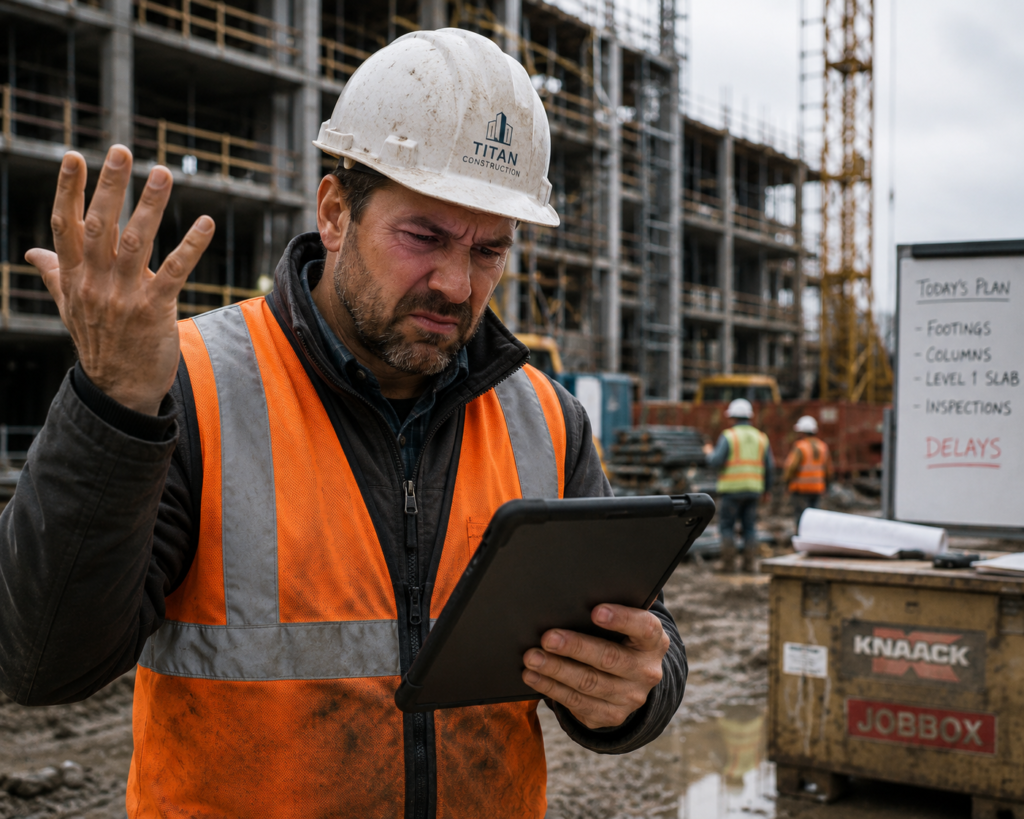
Consider what happens when a crew works from an outdated drawing revision.
The technology problem may have taken seconds to occur.
The operational consequences can take days to recover from.
Labor must be repeated.
Schedules shift.
Inspections may need to be rescheduled.
Profitability suffers.
4. Increased Operational Risk
Technology friction doesn’t just reduce productivity.
It increases risk.
Examples include:
- Untested backups
- Weak access controls
- Inconsistent processes
- Unreliable connectivity
Most contractors don’t notice these risks until something fails.
When failures occur, projects are disrupted.
Recovery becomes expensive.
And profit margins suffer.
Reducing risk is one of the five pillars of the Construction Technology Framework™ for this exact reason.
5. Project Continuity Disruptions
The final category is often the most visible.
When technology disrupts operations directly:
- Inspections are delayed
- Documentation is unavailable
- Teams cannot access critical information
- Decision-making slows
Projects lose momentum.
Learn what operational systems help maintain momentum in What “Keeping Projects Moving™” Actually Requires Behind the Scenes.
Momentum matters.
The longer disruptions persist, the more expensive they become.
This is why the fifth pillar of the framework is not technology.
It is:
Keep Work Moving.
Because operational continuity ultimately determines project performance.
Why High-Performing Contractors Experience Less Friction
Leading construction companies do not eliminate every problem.
They reduce friction systematically.
They establish:
- Standard communication processes
- Reliable field access
- Structured information management
- Risk controls
- Continuity planning
The result is fewer interruptions, greater consistency, and stronger profitability.
Technology becomes an operational asset instead of an operational obstacle.
Real Example
A Southern California contractor managing multiple commercial projects noticed recurring communication and coordination issues between project managers, field supervisors, and subcontractors.
No single problem appeared significant.
But teams repeatedly lost time:
- Tracking down updated drawings
- Confirming project information
- Waiting for responses
- Coordinating between office and field personnel
Leadership initially viewed these issues as normal construction challenges.
When evaluated collectively, they represented dozens of lost productive hours every month.
Project managers reported difficulty locating updated information.
Field personnel frequently called the office for clarification.
Multiple teams maintained duplicate records because they lacked confidence in shared information.
After evaluating operations using the Construction Technology Framework™, several friction points were identified.
The company standardized:
- Communication workflows
- Information management processes
- Field access procedures
Within months:
- Project coordination improved
- Duplicate work decreased
- Internal response times improved
- Operational visibility increased
The company didn’t necessarily work harder.
It worked with less friction.
Why This Matters for Construction Leaders
Many contractors focus on large cost categories while ignoring smaller inefficiencies.
The problem is that small inefficiencies compound.
Technology friction rarely appears on a profit-and-loss statement.
Its impact appears through:
- Reduced productivity
- Slower communication
- Information confusion
- Increased risk
- Project disruption
When leaders address friction systematically, margins improve naturally.
Not because employees work harder.
Because operations work better.
Why Contractors Across Southern California Use M-Squared Networks
For more than a decade, M-Squared Networks has helped construction companies across Orange County, Los Angeles, and the Inland Empire identify technology friction that affects operations.
We’ve seen how communication gaps, disconnected systems, inconsistent access to project information, and unmanaged risk quietly impact productivity and profitability.
The Construction Technology Framework™ was developed from years of helping contractors align technology with operational outcomes.
Because technology should support construction.
Not slow it down.
Final Takeaway
Most contractors know when a major technology failure occurs.
Far fewer recognize the daily friction that slowly erodes profitability.
The companies that gain a competitive advantage are not necessarily those with the newest technology.
They are the companies that remove obstacles to communication, productivity, information flow, risk management, and operational continuity.
In other words:
They reduce friction.
And when friction decreases, projects move more efficiently, teams become more productive, and profit margins become easier to protect.
That’s how you Keep Projects Moving™.
How Much Technology Friction Is Quietly Costing Your Company?
Most contractors don’t realize where communication delays, information gaps, field support challenges, or operational risk are creating hidden costs.
A Construction Technology Review evaluates your company across all five pillars of the Construction Technology Framework™ and identifies opportunities to improve efficiency, reduce risk, and keep projects moving.