


AI is becoming difficult for construction companies to ignore.
Employees are experimenting with tools like ChatGPT, Copilot, Claude, Gemini, and others. AI capabilities are appearing inside software companies already use. And the list of things AI supposedly can do seems to grow every week.
That can make the first question seem obvious:
What can AI do for our company?
But that may not be the best place to start.
When evaluating AI for construction contractors, a better question is:
Where are people already spending time working with information, and could AI help with some of that work?
That changes the conversation from finding something for AI to do to identifying actual work where AI may provide value.
For construction contractors, there are plenty of places worth examining.
Don’t Start With AI. Start With the Work.
AI is a technology.
Like any technology, its value depends on what you’re asking it to support.
Before deciding which AI platform to use or which employees need access, look at the work itself.
Where are people spending time searching for information?
Where are they repeatedly reading through large amounts of project documentation?
Where are rough notes being turned into formal documentation?
Where is information being summarized, organized, compared, or entered again somewhere else?
Where does someone need to prepare a first draft before another person reviews it?
Those are the kinds of activities where AI may be worth investigating.
The objective isn’t to use AI everywhere.
It’s to identify where AI can reduce unnecessary work while still supporting the way the construction company needs to operate.
Here are three examples.
1. Finding the Right Project Information
Construction projects create a lot of information.
Drawings.
Specifications.
RFIs.
Submittals.
Emails.
Revisions.
Project correspondence.
And the question someone needs answered may be buried somewhere inside it.
A superintendent, project manager, estimator, or other employee may know the information exists but still have to determine where it is, whether they’re looking at the right version, and which part applies to the question in front of them.
AI has the potential to help with the search.
Instead of manually opening documents and trying different search terms, an approved AI system with access to the appropriate project information may be able to search across authorized documents, identify relevant passages, compare information, and point someone toward the source.
But finding an answer isn’t the same as determining that the answer is correct.
Someone still needs to verify:
Is this the current revision?
Does this information apply to this condition?
Is the source authoritative?
Has something changed elsewhere in the project information?
Is the interpretation correct?
AI can help find the information. A person still has to determine whether it can be trusted and applied.
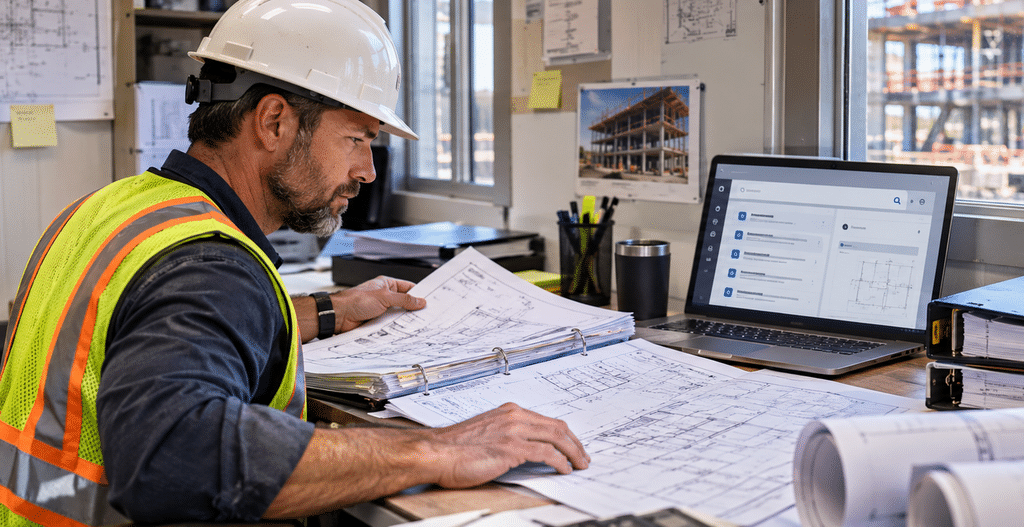
2. Turning Field Information Into Project Documentation
The field already creates information throughout the day.
Notes.
Photos.
Manpower counts.
Deliveries.
Delays.
Completed work.
Questions.
Changing conditions.
Some of that information eventually needs to become documentation someone else can understand and use.
That can require someone to take information captured during the day and turn it into a structured daily report, summary, update, or other project record.
AI may be able to help with that transition.
For example, rough notes or dictated updates could potentially be organized into a draft report. Information could be structured into a consistent format. Missing details could be identified for someone to complete before the report is submitted.
But AI wasn’t standing on the jobsite.
It didn’t see what happened.
It doesn’t automatically know whether the quantities, manpower, conditions, or events described in the draft accurately represent the day.
That makes human verification essential.
AI can help turn information into a draft. The people who know what happened still need to verify the record.
This is also why the quality and context of the information being captured matters.
AI can help work with information.
It cannot reliably recreate context that was never captured in the first place.
3. Working Through Submittals, RFIs, and Specifications
Some construction activities require people to work through substantial amounts of project information.
Specifications need to be reviewed.
Requirements need to be located.
Submittal information needs to be organized.
Questions need to be researched.
RFIs may need to be drafted.
AI may be useful in parts of that work.
It could help locate relevant specification sections, extract requirements, organize information, identify items that deserve additional review, or prepare a first draft of an RFI.
That may reduce some of the repetitive work involved in finding, organizing, and preparing information.
But again, there is an important boundary.
AI doesn’t become responsible for technical compliance, contractual requirements, applicability, or the final response.
The people responsible for the work still need to review what AI produces.
AI can assist with the information-heavy parts of the process. People remain responsible for the construction decision.
A Useful Pattern Starts to Appear
Look at what AI is doing in those examples.
Searching.
Summarizing.
Organizing.
Comparing.
Extracting.
Drafting.
Identifying information for review.
Those are different from:
Approving.
Authorizing.
Accepting.
Determining contractual compliance.
Making a technical decision.
Deciding what happens on the project.
That distinction matters.
AI can help people work through information and reduce some repetitive effort without becoming the person responsible for the outcome.
A useful way to think about it is:
AI assists. People verify.
That doesn’t mean every AI output needs the same type of review.
It means responsibility doesn’t disappear because AI helped produce the answer.
The Information AI Uses Matters Too
Once a useful AI opportunity has been identified, another question appears:
What information does the AI need in order to help?
That question is especially important in construction.
Project information may involve owners, architects, engineers, general contractors, subcontractors, vendors, employees, customers, and other parties.
Drawings and specifications may have come from someone else.
Bid information may contain information provided by subcontractors or vendors.
Estimates may contain information the contractor considers sensitive.
The question isn’t only whether AI can perform a task.
The company also needs to understand what information is being provided to the AI, which tool is receiving it, who has access, and what guidelines apply.
That is part of taking a more deliberate approach to AI in a construction company.
Those questions deserve their own discussion.
For now, the important point is that:
A useful AI use case and an appropriate AI use case aren’t automatically the same thing.
AI Makes the Fundamentals More Important
AI doesn’t replace the construction technology principles we’ve been discussing.
It depends on them.
If information isn’t current, context is missing, or responsibilities aren’t clear, AI doesn’t automatically correct those problems.
In many ways, AI makes the fundamentals more important, not less.
Technology supports processes.
Processes create trusted information.
Trusted information enables AI.
People remain responsible for decisions.
Better Decisions Keep Projects Moving™.
Start With a Real Problem Worth Solving
Construction companies don’t need to find a use for AI simply because AI is available.
Start with the operation.
Look for work that consumes time because people have to search, organize, compare, summarize, extract, or draft information.
Then ask:
Could AI help with this part of the work?
What information would it need?
What would a person still need to verify?
What happens if the AI is wrong?
Which AI tool would be appropriate?
What guidelines or controls should apply?
Those questions lead to a much more useful AI conversation than starting with a list of features.
The goal isn’t to put AI everywhere.
It’s to understand where it can actually help, where people still need to remain responsible, and how it should fit into the way the construction company operates.
That’s Construction First. Technology Second.
Better Decisions Keep Projects Moving™.
Understand Where AI Fits in Your Construction Company
AI can create real opportunities for construction contractors, but choosing an AI tool shouldn’t be the first step.
A Construction Technology Review™ looks at how your people, processes, project information, and technology work together before determining where technology should change.
Using the Construction Technology Framework™ and its Operational Foundations, we can look at where people spend time working with information, where AI may be able to assist, what information those tools would need, and where appropriate standards, training, and governance should be considered.
The objective isn’t to put AI everywhere.
It’s to identify where AI can provide practical value while keeping people responsible for the work and decisions that matter.
Start with the work. Then determine where AI belongs.