
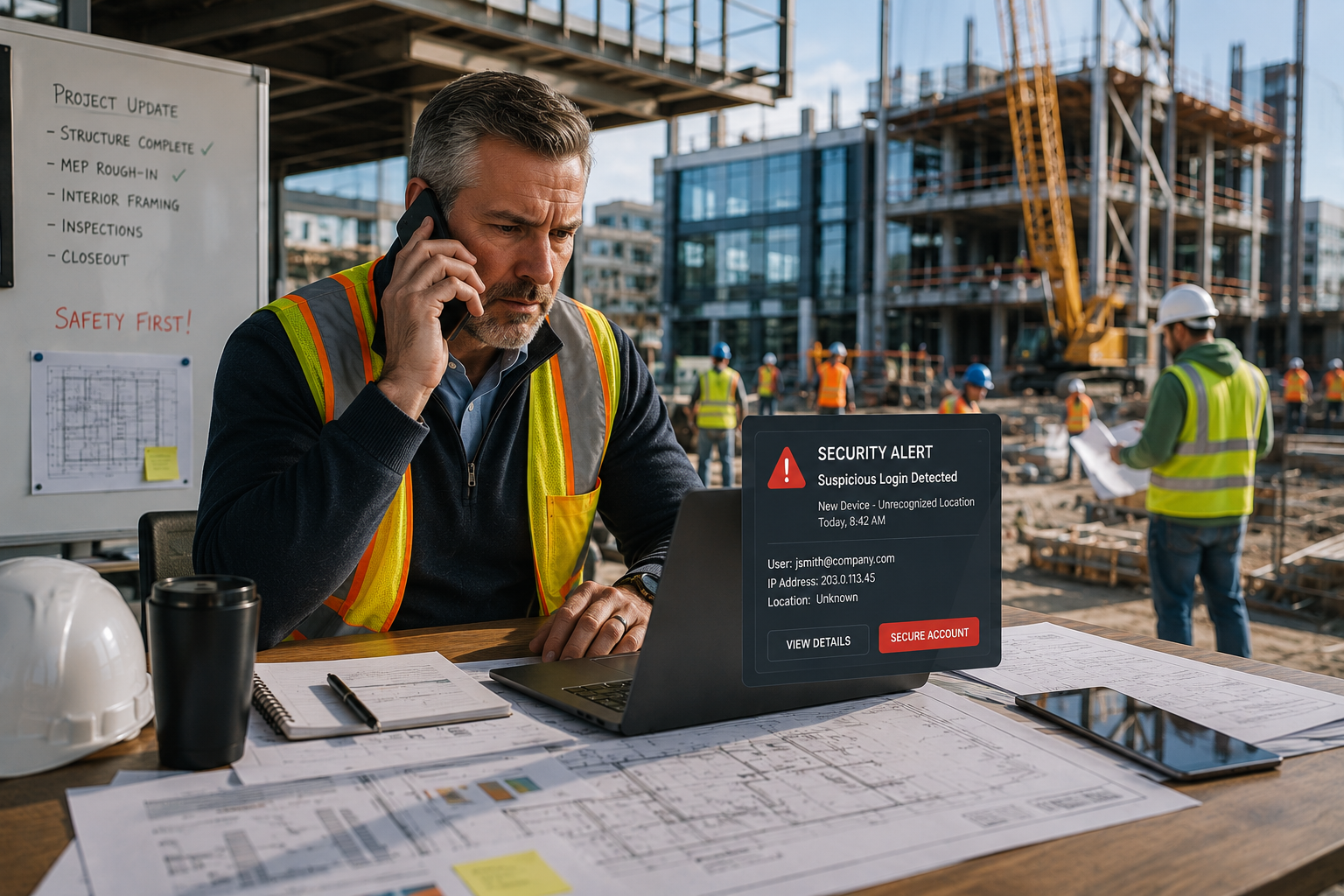
When most construction companies think about cybersecurity, they think about hackers.
Ransomware.
Viruses.
Data breaches.
Those threats are real.
But for contractors, cybersecurity isn’t simply an IT issue.
It’s an operations issue.
The biggest question isn’t:
“Will we be attacked?”
The real question is:
“Can our projects continue if something goes wrong?”
Because when a cyber incident disrupts communication, project information, scheduling, payroll, procurement, or field operations, technology is no longer the problem.
Project continuity is.
Operational continuity is one of the core systems discussed in What “Keeping Projects Moving™” Actually Requires Behind the Scenes.
That’s why Reduce Risk is one of the five pillars of the Construction Technology Framework™.
Learn how all five pillars work together in The 5 Pillars of the Construction Technology Framework™.
Its purpose isn’t simply to secure technology.
Its purpose is to protect operations so your company can continue to Keep Projects Moving™.
Construction Companies Depend on Technology More Than Ever
Today’s construction companies rely on technology throughout every phase of a project.
Office teams manage estimating, accounting, scheduling, and project management.
Field personnel access drawings, RFIs, specifications, punch lists, inspections, and daily reports from mobile devices.
Communication happens continuously between:
- Project managers
- Superintendents
- Foremen
- Office staff
- Vendors
- Subcontractors
- Clients
When those systems become unavailable, work doesn’t simply become inconvenient.
It slows.
Decisions are delayed.
Information becomes difficult to access.
Productivity drops.
The longer the disruption lasts, the greater the impact on the project.
What Cybersecurity Really Protects
Many business owners think cybersecurity exists to protect computers.
In reality, it protects operations.
Strong cybersecurity helps protect:
- Project documentation
- Communication systems
- Financial information
- Vendor relationships
- Client confidence
- Business continuity
Without these systems, even well-managed projects become difficult to coordinate.
Cybersecurity is not about preventing every attack.
It is about minimizing disruption when incidents occur.
The Operational Cost of a Cyber Incident
A ransomware attack doesn’t just encrypt files.
It interrupts business.
Construction companies may suddenly lose access to:
- Current project drawings
- Change orders
- RFIs
- Scheduling systems
- Procurement information
- Accounting systems
- Payroll
- Cloud storage
Losing access to trusted project information can be just as damaging as using outdated information, as discussed in The True Cost of Outdated Drawings and Project Information.
Field teams continue arriving at jobsites.
Subcontractors continue asking questions.
Clients continue expecting updates.
Projects continue moving.
Leadership suddenly loses visibility.
The technology problem quickly becomes an operational problem.
This is another example of the hidden operational friction discussed in How Technology Friction Quietly Reduces Construction Profit Margins.
Why Prevention Alone Isn’t Enough
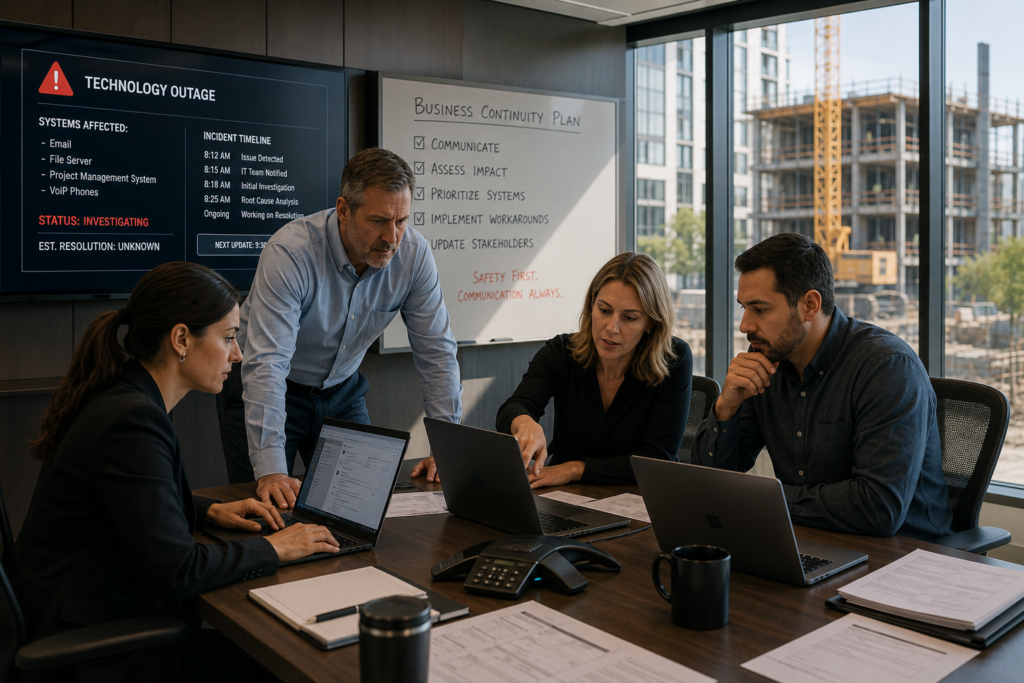
No cybersecurity program can guarantee that an incident will never occur.
That isn’t a realistic goal.
The companies that recover fastest prepare before an incident happens.
That preparation includes:
- Reliable backups
- Disaster recovery planning
- Multi-factor authentication
- Employee security awareness
- Incident response procedures
- Business continuity planning
These systems reduce downtime.
They reduce confusion.
Most importantly, they reduce operational disruption.
Preparation is what separates a temporary inconvenience from a prolonged business interruption.
Reduce Risk: The Fourth Pillar of the Construction Technology Framework™
The objective is not simply preventing cyber threats.
It is reducing operational risk across the entire organization.
This pillar focuses on:
- Cybersecurity
- Business continuity
- Disaster recovery
- Access management
- Data protection
- Operational resilience
Because protecting technology is only valuable if it protects project execution.
Real Example
A Southern California contractor experienced a cybersecurity incident that temporarily disrupted access to several internal systems.
The attack itself was contained quickly.
The greater challenge was maintaining day-to-day operations.
Project managers needed current drawings.
Field supervisors required updated documentation.
Accounting needed access to financial systems.
Leadership needed visibility into active projects.
Because backup procedures, recovery planning, and communication processes had already been established, operations continued with limited disruption while systems were restored.
The lesson wasn’t simply about cybersecurity.
It was about preparedness.
Technology recovered because operational continuity had already been planned.
Why This Matters for Construction Leaders
Construction leaders don’t purchase cybersecurity because they enjoy buying security software.
They invest in cybersecurity because projects cannot stop.
Employees need information.
Clients expect progress.
Subcontractors require communication.
Schedules continue moving.
The companies that perform best during unexpected disruptions are rarely the companies with the most technology.
They are typically organizations that view technology as an operational strategy rather than simply an IT function, as discussed in Why Most MSPs Don’t Understand Construction Operations.
They are the companies that prepared for continuity before they needed it.
Why Contractors Across Southern California Use M Squared Networks
For more than a decade, M Squared Networks has helped construction companies throughout Orange County, Los Angeles County, Riverside County, and the Inland Empire strengthen cybersecurity while protecting day-to-day operations.
We’ve seen how quickly a technology problem can become a project problem when continuity planning is overlooked.
The Construction Technology Framework™ was developed to help contractors reduce operational risk, improve resilience, and maintain project momentum.
Because cybersecurity isn’t about protecting computers.
It’s about protecting your ability to Keep Projects Moving™.
Final Takeaway
Construction companies don’t measure success by how many cyber threats they block.
They measure success by whether projects continue moving.
Strong cybersecurity is important.
Operational resilience is what keeps construction companies productive when unexpected events occur.
The contractors best prepared for the future don’t simply invest in technology.
They invest in systems that protect communication, project information, field operations, and continuity.
That’s the purpose of the Reduce Risk pillar of the Construction Technology Framework™.
And that’s another way successful contractors Keep Projects Moving™.
Is Your Company Prepared to Keep Working During a Cyber Incident?
Most contractors focus on preventing cyberattacks.
Fewer evaluate how well their operations would continue if one occurred.
A Construction Technology Review evaluates cybersecurity, business continuity, disaster recovery, and operational resilience across all five pillars of the Construction Technology Framework™.