


Most construction leaders understand that communication is important.
Few realize how expensive poor communication can become.
Communication breakdowns rarely appear as major failures.
Instead, they show up as small interruptions:
- Delayed responses
- Missed updates
- Incomplete information
- Unanswered RFIs
- Conflicting instructions
- Misaligned expectations
Individually, these issues seem manageable.
Collectively, they create operational friction that slows projects, reduces productivity, increases stress, and impacts profitability.
Many of these hidden costs are explored in How Technology Friction Quietly Reduces Construction Profit Margins.
Many contractors view communication as a people problem.
Communication breakdowns often begin when technology and operations become disconnected, as discussed in The Construction Technology Framework™: Why IT and Field Operations Don’t Align
In reality, communication is often a systems problem.
When communication systems are inconsistent, projects become harder to manage.
This is why Connect Teams is the first pillar of the Construction Technology Framework™.
Because projects move at the speed of communication.
Communication is one of the foundational systems discussed in What “Keeping Projects Moving™” Actually Requires Behind the Scenes
And when communication slows down, everything else slows down with it.
Why Communication Matters More Than Most Contractors Think
Construction projects depend on hundreds of daily decisions.
Information constantly moves between:
- Owners
- Project managers
- Superintendents
- Office staff
- Subcontractors
- Vendors
- Inspectors
Every handoff creates the potential for misunderstanding.
Every delay creates the potential for disruption.
A project schedule may look perfect on paper.
But if information doesn’t reach the right people at the right time, productivity suffers.
The challenge is that communication issues rarely appear as communication issues.
Instead they show up as:
- Delays
- Rework
- Scheduling conflicts
- Missed deadlines
- Field frustration
By the time leadership notices the symptom, the communication breakdown has already occurred.
The Hidden Cost of Communication Breakdowns
Most contractors underestimate the financial impact of communication problems because the costs are spread throughout the project.
Examples include:
Delayed Decisions
Projects often slow when key information is unavailable.
Approvals take longer.
Questions remain unanswered.
Work waits.
Momentum suffers.
Rework
Teams operating from incomplete information are more likely to perform work incorrectly.
The communication failure may have taken seconds.
The correction can take days.
Reduced Productivity
Employees spend valuable time tracking down information rather than performing productive work.
Frustration
Poor communication creates stress throughout the organization.
Teams become reactive.
Confidence decreases.
Accountability becomes more difficult.
Project Delays
Multiple small communication issues eventually create larger schedule impacts.
What begins as a communication problem often becomes an operational problem.
Why Communication Problems Usually Aren’t Caused By People
This is one of the biggest misconceptions in construction.
When communication fails, organizations often assume employees are the problem.
Most of the time, they are not.
More commonly, the issue is that communication systems are inconsistent.
Examples include:
- Information stored in multiple locations
- Different communication methods used by different teams
- Project updates distributed inconsistently
- Lack of standardized processes
- Unclear ownership of information
Good people working inside inconsistent systems will still experience communication problems.
Improving communication usually requires improving the system.
Not replacing the people.
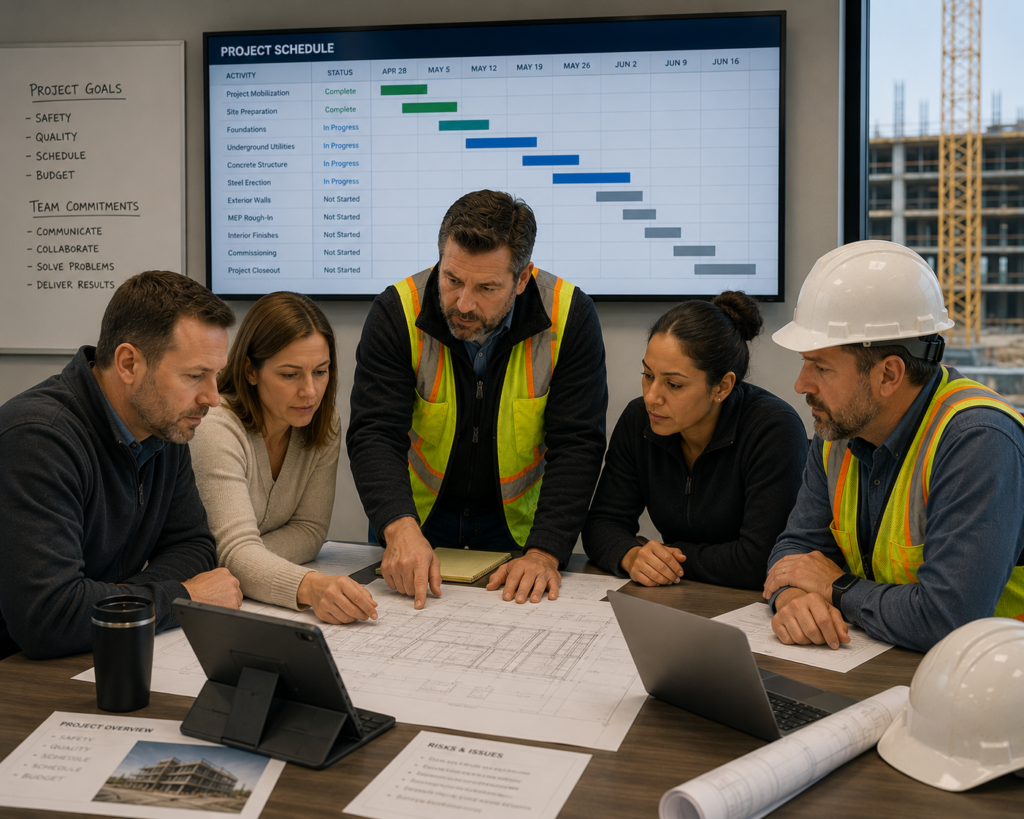
What High-Performing Contractors Do Differently
Leading contractors recognize communication as operational infrastructure.
They do not leave communication to chance.
They establish standards.
They create consistency.
They ensure project information flows efficiently between office and field personnel.
High-performing contractors typically focus on:
- Standard communication processes
- Consistent project updates
- Reliable access to information
- Clear accountability
- Defined communication ownership
As a result:
- Decisions happen faster
- Coordination improves
- Productivity increases
- Friction decreases
Communication becomes a competitive advantage.
Connect Teams: The First Pillar of the Construction Technology Framework™
The first pillar of the Construction Technology Framework™ is:
Connect Teams
Learn more about the complete framework in The 5 Pillars of the Construction Technology Framework™.
The objective is simple:
Ensure the right information reaches the right people at the right time.
This pillar focuses on:
- Communication workflows
- Information accessibility
- Collaboration processes
- Coordination standards
- Operational visibility
Because every other pillar depends on communication.
Field support depends on communication.
Project information depends on communication.
Risk management depends on communication.
Project continuity depends on communication.
When communication improves, everything else becomes easier.
Real Example
A Southern California contractor experienced recurring project delays that initially appeared unrelated.
Field teams reported inconsistent information.
Project managers struggled to confirm project updates.
Subcontractors occasionally worked from outdated instructions.
No major communication failure existed.
Instead, dozens of small communication gaps were occurring throughout the organization.
Leadership initially viewed these issues as isolated frustrations.
After evaluating communication processes through the Construction Technology Framework™, the company discovered communication standards varied significantly between projects.
By standardizing communication workflows, clarifying ownership, and improving information accessibility, the company experienced:
- Faster decision-making
- Improved project coordination
- Better field communication
- Reduced operational friction
The technology remained largely unchanged.
The communication system improved.
Why This Matters for Construction Leaders
Communication affects every operational outcome.
When communication improves:
- Productivity improves
- Visibility improves
- Accountability improves
- Project execution improves
When communication breaks down:
- Delays increase
- Frustration increases
- Risk increases
- Profitability suffers
Construction leaders often focus on solving visible problems.
The most effective leaders focus on improving the systems that create those outcomes.
Communication is one of those systems.
Why Contractors Across Southern California Use M Squared Networks
For more than a decade, M Squared Networks has helped construction companies throughout Orange County, Los Angeles County, Riverside County, and the Inland Empire improve communication, operational consistency, and project execution.
We’ve seen how communication breakdowns create unnecessary friction across projects.
The Construction Technology Framework™ was developed to help contractors align technology and operations around one objective:
Keep Projects Moving™.
Because projects don’t slow down when communication is perfect.
They slow down when communication becomes inconsistent.
Final Takeaway
Most communication breakdowns don’t appear dramatic.
They appear ordinary.
A missed update.
A delayed response.
A forgotten document.
An unanswered question.
Yet over time, these small issues create significant operational friction.
The contractors that consistently outperform competitors are those that treat communication as a critical operational system.
Not simply a daily activity.
Because projects move at the speed of communication.
And when communication improves, projects move more predictably.
How Strong Are Your Communication Systems?
Most contractors don’t evaluate communication as a formal operational system.
A Construction Technology Review evaluates communication workflows, information accessibility, field coordination, and operational consistency across all five pillars of the Construction Technology Framework™.