

Construction companies across Southern California (Orange County, Inland Empire, and Los Angeles) are increasingly required to meet cybersecurity standards to qualify for cyber insurance.
For companies with 20–100 employees, failing a cyber insurance audit can result in:
- Higher premiums
- Reduced coverage
- Denied claims after an incident
Preparing properly is no longer optional — it’s required.
Here’s how construction companies should prepare.
1. Understand What Cyber Insurance Providers Require
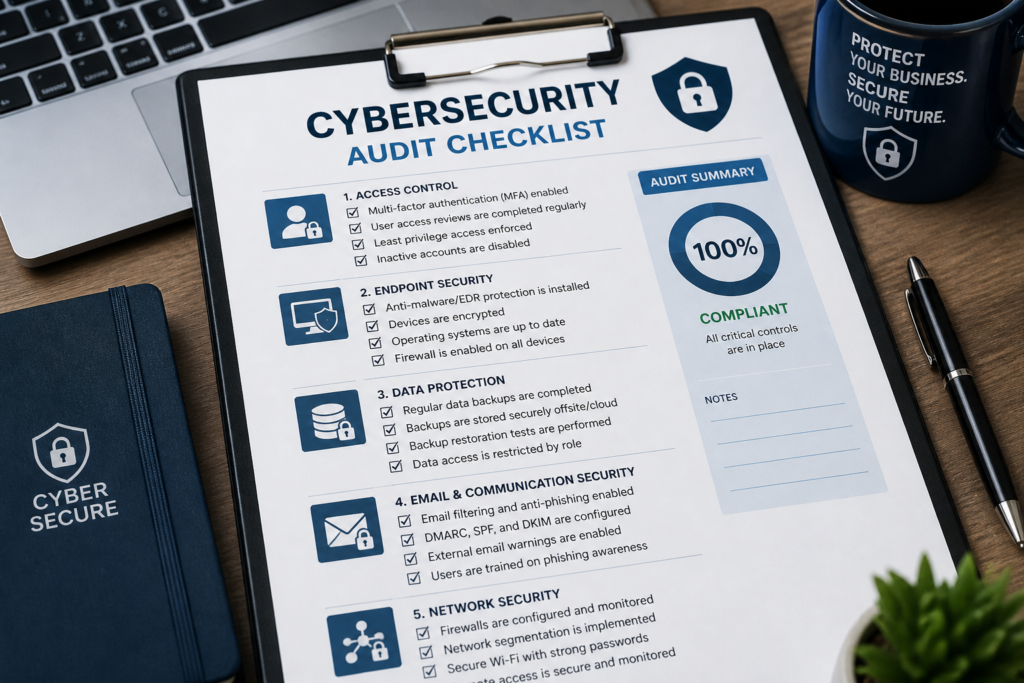
Most policies now require proof of:
- Multi-factor authentication (MFA)
- Endpoint protection
- Secure backups
- Email security controls
- Access management policies
These are not just recommendations — they are baseline requirements.
2. Enforce Multi-Factor Authentication (MFA) Everywhere
MFA should be enabled across:
- Email systems (Microsoft 365)
- Cloud platforms (Procore, SharePoint)
- Remote access tools
Without MFA, many insurance providers will either deny coverage or increase premiums.
3. Secure All Devices (Endpoint Protection)
Every device accessing company data should be:
- Monitored
- Protected with antivirus/EDR
- Updated regularly
Construction environments often include:
- Field laptops
- Tablets
- Personal devices
These must all meet security standards.
Not sure where you stand? We help construction companies identify IT risks, insurance gaps, and jobsite issues before they become problems.
4. Implement Reliable Backup & Recovery
Insurance providers require:
- Automated backups
- Offsite/cloud storage
- Verified recovery processes
Backups must be:
- Secure
- Tested regularly
- Protected from ransomware
Backup is critical. Learn how cloud backup and disaster recovery works for construction companies.
5. Control Access to Sensitive Data
Construction companies should implement:
- Role-based access controls
- Limited admin privileges
- Secure file sharing
This ensures that employees only access the data they need.
6. Document Your Security Policies
Cyber insurance audits often require documentation of:
- Security procedures
- Incident response plans
- Access policies
Even if systems are secure, lack of documentation can cause audit failures.
Real Example
A contractor in Los Angeles applied for cyber insurance but failed the initial audit due to:
- No MFA enforcement
- Inconsistent device security
- Lack of documented policies
After implementing required controls:
- The company passed the audit
- Premiums were reduced
- Coverage improved
Final Takeaway
Cyber insurance audits are becoming stricter — and construction companies must be prepared.
Meeting requirements isn’t just about passing an audit — it’s about protecting your business from real-world threats.
Security requirements continue to evolve. Learn how to secure Procore for construction companies.
Talk to a Construction IT Expert
If you’re a general contractor or subcontractor with 20–100 employees and want to understand your real IT risks, costs, or gaps, talk to an expert who specializes in construction environments.
No pressure. Just clear answers.